
5 Best Myofascial Release Tools for Pelvic Floor and Core Recovery at Home
This post contains affiliate links — I only recommend products I personally use and recommend to my patients.
If you’ve been stretching, strengthening, doing the pelvic floor exercises, maybe even seeing a PT — but the tension, pressure, leaking, or pain keeps returning — there’s a missing piece.
Most women are trying to strengthen a system that is still compressed.
Chronic fascial restriction does not respond to strengthening or stretching alone. When fascia remains dense, guarded, and neurologically braced, the body cannot coordinate pressure well.
The pelvic floor compensates.
The diaphragm loses excursion.
The rib cage stiffens.
And symptoms continue cycling.
This is where myofascial release tools become incredibly important.
The right self-myofascial release tools help restore tissue glide, decompress chronic tension patterns, improve pressure regulation, and create the conditions the body needs to heal, especially during postpartum core recovery.
Why Myofascial Release Has to Come First
One of the biggest mistakes I see as a Physical Therapist treating pelvic floor dysfunction is trying to build strength on top of a system that is still braced.
You cannot out-strengthen chronic compression patterns.
When fascia becomes restricted and the nervous system shifts into protective mode, your body begins gripping instead of coordinating. In this state, strengthening often reinforces the exact compensation patterns we are trying to resolve.
Chronic sitting, stress, pregnancy, and postpartum bracing all create tension and restriction through the rib cage, spine, hips, glutes, and pelvic floor.
Over time, the body loses elasticity. The diaphragm stops moving well. The rib cage stiffens. The pelvis compensates. And the pelvic floor often tightens or takes on more load than it should.
Many women also develop trigger points through the glutes and deep hip muscles. When the glutes are tight, inhibited, and not functioning well, the pelvic floor compensates for stability and pressure management instead.
This compensation pattern is extremely common in women with pelvic floor tension, pelvic pain, tailbone pain, and prolapse symptoms. The pelvic floor cannot fully relax, lengthen, or regulate pressure well if the system around it remains restricted.
Myofascial release helps restore mobility, improve tissue glide, decrease protective tension, and create the conditions the body needs to heal.
Healing starts by restoring function — not forcing strength.
The 5 Best Myofascial Release Tools (and What Each One Does)
1. MA Roller
The MA Roller is one of the most used tools in my own practice because it addresses something most women never directly work on: posterior fascial compression.
Chronic sitting, pregnancy, stress, and protective bracing create density along the paraspinals and thoracolumbar fascia. Over time, this region stiffens. When the posterior chain loses elasticity, pressure regulation changes. The diaphragm loses excursion. The rib cage becomes rigid. The pelvis compensates. The pelvic floor tightens or bears more load than it should.
I use the MA Roller specifically to create space between the vertebrae and improve spinal alignment.
When there is vertebral rotation, scoliosis, chronic back pain, or sacroiliac joint dysfunction, this tool can be a game changer. By gently encouraging decompression along the spine, it helps restore segmental mobility and reduce asymmetric loading patterns that disrupt the entire core pressure system.
The MA Roller improves rib mobility, supports fascial hydration, and creates the structural space necessary for proper pressure mechanics.
It is not just “rolling.” It is restoring spinal elasticity so the core system can coordinate reflexively instead of compensating.
Best for:
- Spinal tension
- Neck pain
- Headaches
- Back pain
- Pelvic floor dysfunction
- SIJ dysfunction
- Rib cage rigidity
- Pressure regulation issues
- Postpartum bracing patterns
2. Spikey Mobility Ball
The spikey mobility ball is my tool of choice for deeper, more chronic trigger point release, particularly in the glutes, hips and posterior pelvic floor.
Trigger points in the gluteal complex frequently refer pain into the pelvic floor. But the issue is not just referred pain.
When the glutes are filled with trigger points and unable to generate force effectively, they stop doing their job. The pelvic floor then compensates for what the glutes are meant to manage — especially load transfer and pelvic stability.
Chronic gripping in the deep rotators, piriformis, and surrounding fascia maintains the pelvic floor in a high-tone state. Over time, this creates a system that cannot lengthen appropriately, cannot recoil efficiently, and cannot regulate pressure reflexively.
The spikey texture allows for more direct and efficient myofascial release. It increases localized circulation, decreases protective guarding, and reintroduces neural variability into tissues that have been locked in contraction patterns for years.
Because of its texture, it often requires less time to effectively release a trigger point compared to a smooth ball, making it both precise and efficient.
This tool is particularly powerful for women navigating:
- Chronic low back pain
- Tailbone pain
- Pelvic pain
- Prolapse symptoms
- Pelvic congestion
- Deep hip tension
- Knee, ankle or foot problems
When the posterior chain softens and re-engages appropriately, the pelvic floor follows.
One of my favorite ways to use this tool is:
- Place the ball under one hip
- Bring the leg into a Figure 4 position
- Gently rock side to side
- Hold still and breathe when you find a tender spot
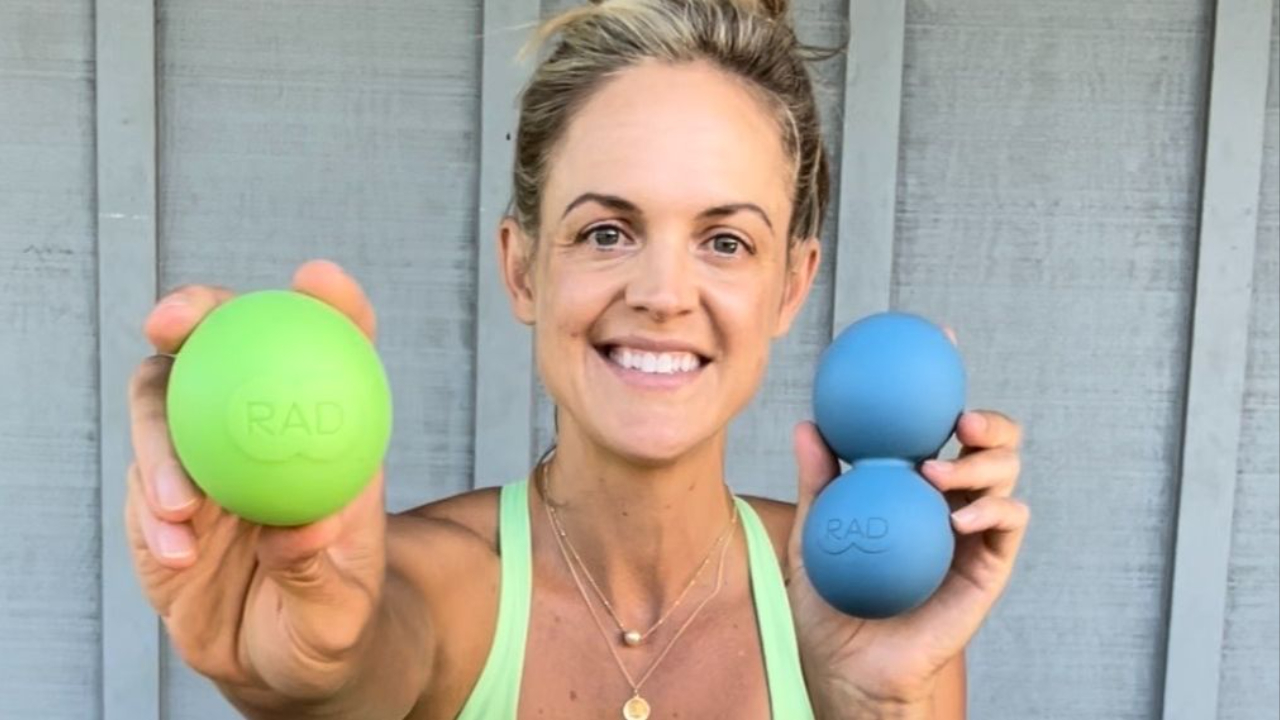
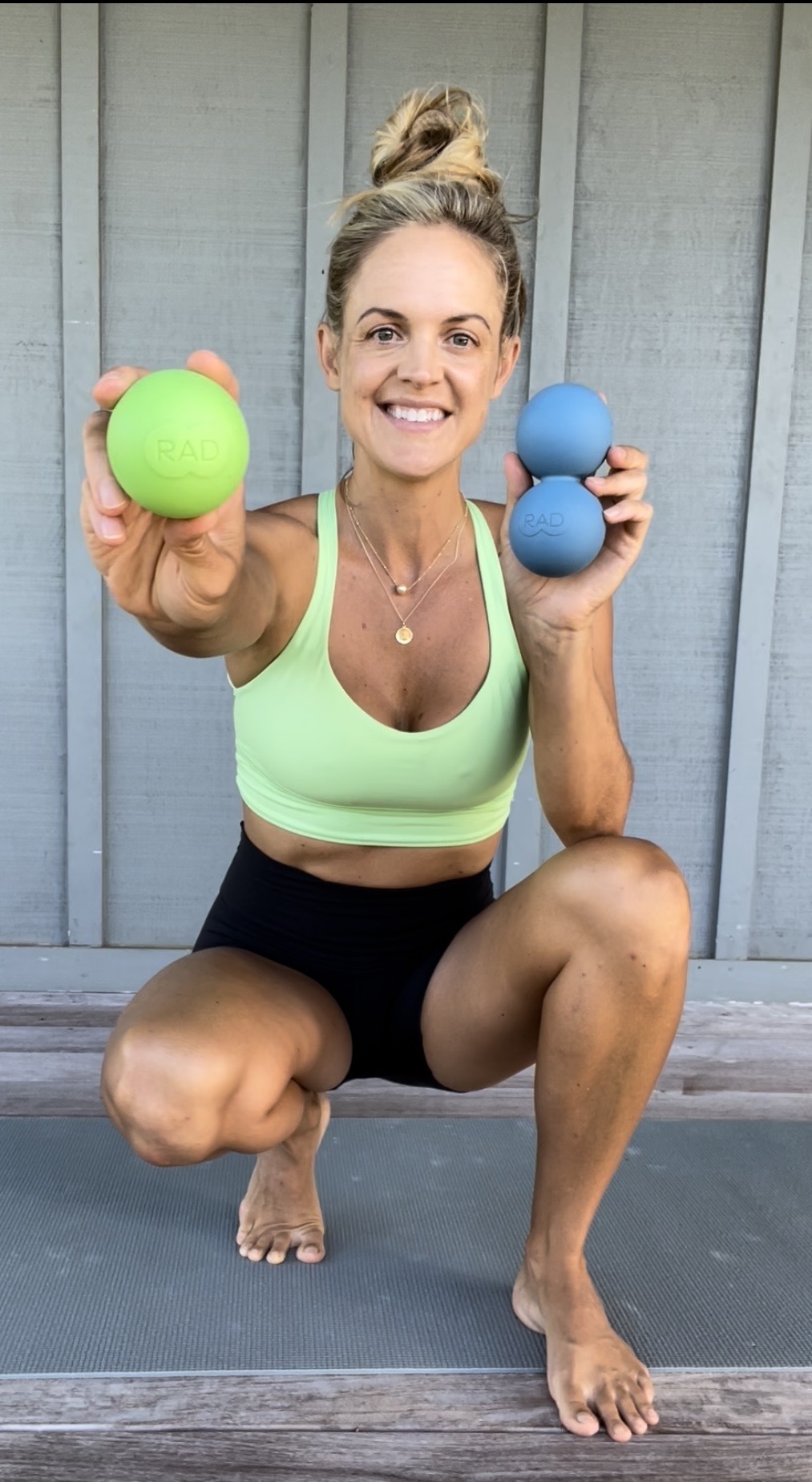
3. Smooth Mobility Ball
The smooth mobility ball serves a very different purpose than the spikey ball.
Where the spikey texture is ideal for breaking up chronic density and deeply embedded trigger points, the smooth ball allows for more nuanced, regulatory work, particularly in tissues that are reactive, inflamed, or neurologically guarded.
Many women I work with are not simply “tight.”
Their tissues are protective.
There is a difference.
When fascia has been living in a chronic stress state — postpartum, during prolonged emotional stress, or after years of bracing — the nervous system increases tone as a protective strategy. In this context, aggressive input can reinforce guarding rather than resolve it.
The smooth ball provides sustained, lower-intensity pressure that allows the nervous system to downshift while the tissue gradually softens.
This is particularly important for women with:
- Pelvic pain
- Prolapse symptoms
- Hypertonic pelvic floor patterns
- Chronic abdominal gripping
- Hip flexor compression
- Rib and diaphragm restriction
I most often use it for:
- Hip flexor decompression, where chronic shortening pulls the pelvis into anterior tilt and disrupts pressure regulation
- Gentle external pelvic floor release, especially around the ischial tuberosities and obturator internus
- Rib and diaphragm mobility, to improve true 360° expansion and restore pressure gradients
- Shoulder and thoracic tension patterns that restrict upper rib mobility and limit diaphragm descent
The diaphragm and pelvic floor are functionally linked. If the rib cage cannot expand and recoil efficiently, the pelvic floor must compensate.
When working with a system that is already overwhelmed, intensity is rarely the answer.
The smooth ball allows us to introduce mechanical change without triggering further sympathetic activation. It creates space for tissue to soften, hydrate, and reorganize — rather than defend.
4. Peanut Ball
The peanut ball is one of my favorite tools for decompressing the sacrum, lumbar fascia, and pelvic floor when these areas are in a highly inflamed state.
The peanut ball straddles the spine and is less intense than the MA roller. This makes it ideal for women who are highly reactive, sensitive to spinal pressure, or carrying significant tension through the sacrum and low back.
The pelvic floor and diaphragm cannot move effectively if the sacrum and lumbar fascia remain restricted.
This tool is particularly helpful for:
- Sacral tension
- Tight pelvic floor muscles
- Pelvic pressure
- Tailbone pain
- Low back stiffness
- Women who cannot tolerate the MA roller
One of my favorite ways to use this tool is in a supported deep squat with a yoga block to release the pelvic floor.
View this post on Instagram
Place the peanut ball on top of a yoga block between the sit bones while supported in the squat position. This allows direct decompression and release work through the pelvic floor muscles while the hips and sacrum relax.
I also frequently use the peanut ball through the sacrum, low back, and rib cage:
Start with the sacrum:
- Place the roller balls under the sacrum
- Tilt the pelvis forward and backward
- Hold still and breathe when you find a tender spot
Next the lower back:
- Move the roller balls up into the lower back
- Tilt the pelvis forward and backward
- Hold still and breathe when you find a tender spot
Then the mid back:
- Place the roller balls at the bottom of the rib cage
- Let the knees fall side to side to rotate the spine
- Hold still and breathe when you find a tender spot
5. Therawand
The Therawand is one of the most misunderstood — and most transformative — tools in pelvic floor rehabilitation.
While many people think of it as purely an internal device, it can be used both internally and externally. When used appropriately, it becomes a precise instrument for restoring pelvic floor elasticity, resolving pain patterns, and rebalancing tone.
Internal tightness is incredibly common in women with:
- Painful intercourse
- Pelvic pressure or heaviness
- Chronic constipation or incomplete emptying
- Hemorrhoids
- Tailbone pain
- Guarded core patterns
- Prolapse
- Diastasis
The pelvic floor is not meant to live in constant contraction.
Yet for many women — especially postpartum, after trauma, during chronic stress, or with longstanding glute inhibition — it does.
If the pelvic floor remains in a state of high tone, no amount of strengthening will create stability.
Stability requires excursion.
It requires lengthening and recoil.
It requires the ability to yield.
The Therawand allows for gentle, intentional trigger point release internally along the levator ani, obturator internus, and posterior pelvic floor. It can also be used externally around the perineum, ischial tuberosities, and tailbone region to address superficial guarding and hemorrhoidal tension patterns.
For women navigating painful intercourse, this tool can be a game changer. By restoring length-tension balance and decreasing localized trigger point activity, the pelvic floor can relearn how to relax and respond reflexively instead of bracing.
For women with hemorrhoids or chronic straining, releasing posterior pelvic floor density and anal sphincter muscle can reduce pressure overload and improve circulation, supporting healthier bowel mechanics and tissue recovery.
When used with proper instruction and awareness, the Therawand is not about force. It is about precision.
It restores tissue elasticity so the pelvic floor can coordinate with the diaphragm and abdominal wall the way it was designed to.
Where to Start
You do not need every tool all at once.
The best place to start depends on the presentation of your symptoms and how reactive your system feels right now.
If your tissue feels reactive, inflamed, or you are just beginning: start with the smooth mobility ball.
If you have chronic density, glute tension, tailbone pain, or low back pain: start with the spikey ball or peanut ball.
If you feel stiff through the spine or rib cage, or struggle with SIJ dysfunction: start with the MA Roller.
If you are dealing with internal tightness, painful intercourse, or incomplete emptying: the Therawand can be incredibly helpful with proper guidance.
All of these tools are linked in my Amazon storefront.
Healing starts by restoring function — not forcing strength.
The body heals best when tissues can glide, pressure can move efficiently, and the nervous system no longer feels the need to brace for protection.
These tools help create the conditions your body needs to do what she already knows how to do.
Inside The Core Recovery Method®, I teach the full guided system for restoring pressure regulation, breathing mechanics, core coordination, and pelvic floor function — including exactly how to sequence these release techniques for real, lasting recovery.
Because true healing is not just about strengthening the core.
It is about restoring the system underneath it.

