
How to Fix a C-Section Shelf: Why It’s Not Fat and What Actually Works
You finally lose the baby weight… but your lower belly still protrudes.
The bulge above your scar is still there.
Your abdomen feels weak. Your scar feels tight, numb, or stretched. Maybe your clothes still don’t fit the way they used to, and no matter how much you exercise or how many core workouts you try, that little “shelf” above your C-section scar doesn’t seem to budge.
It’s frustrating. And for many women, it’s confusing.
Because you’re doing everything you’ve been told to do. You’ve exercised. You’ve lost weight. You’ve tried to strengthen your core.
And yet your body still doesn’t feel like your own.
Most women are told that a C-section shelf is simply stubborn fat or loose skin. But if that were true, every woman who lost weight after pregnancy would see it disappear. We know that’s not the case.
In my experience as a Doctor of Physical Therapy specializing in women’s health, a C-section shelf is often a sign that your body still needs support and restoration after pregnancy and surgery. More specifically, it’s usually a reflection of how your core muscles are functioning, how pressure is being managed inside your abdomen, and how well your body is supporting your organs.
Because contrary to popular belief, the shape of your lower belly isn’t simply a cosmetic issue. It’s a clue. A clue that your body is still carrying pressure patterns and compensations that developed during pregnancy and never fully resolved.
Your body isn’t broken, and this isn’t something you simply have to accept.
Once you understand why a C-section shelf happens in the first place, you can stop fighting your body and start giving her exactly what she needs to heal.
What is a C-Section Shelf?
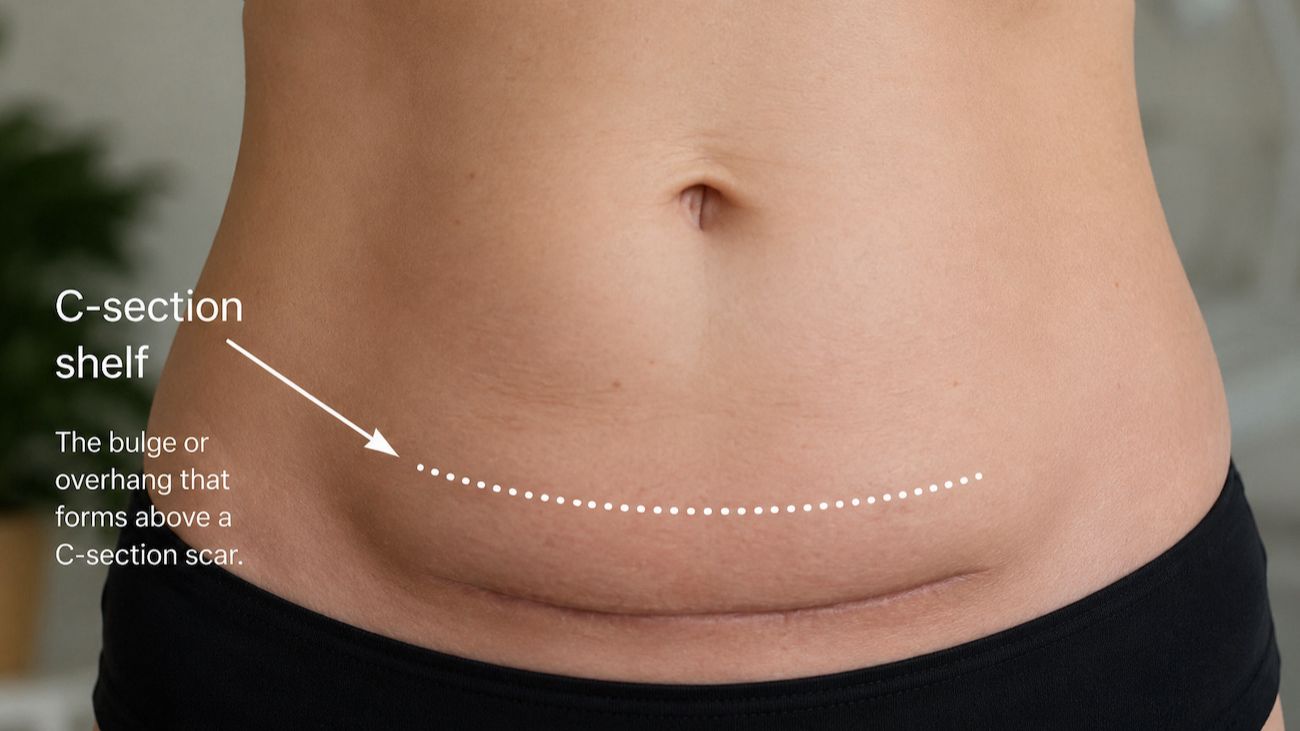
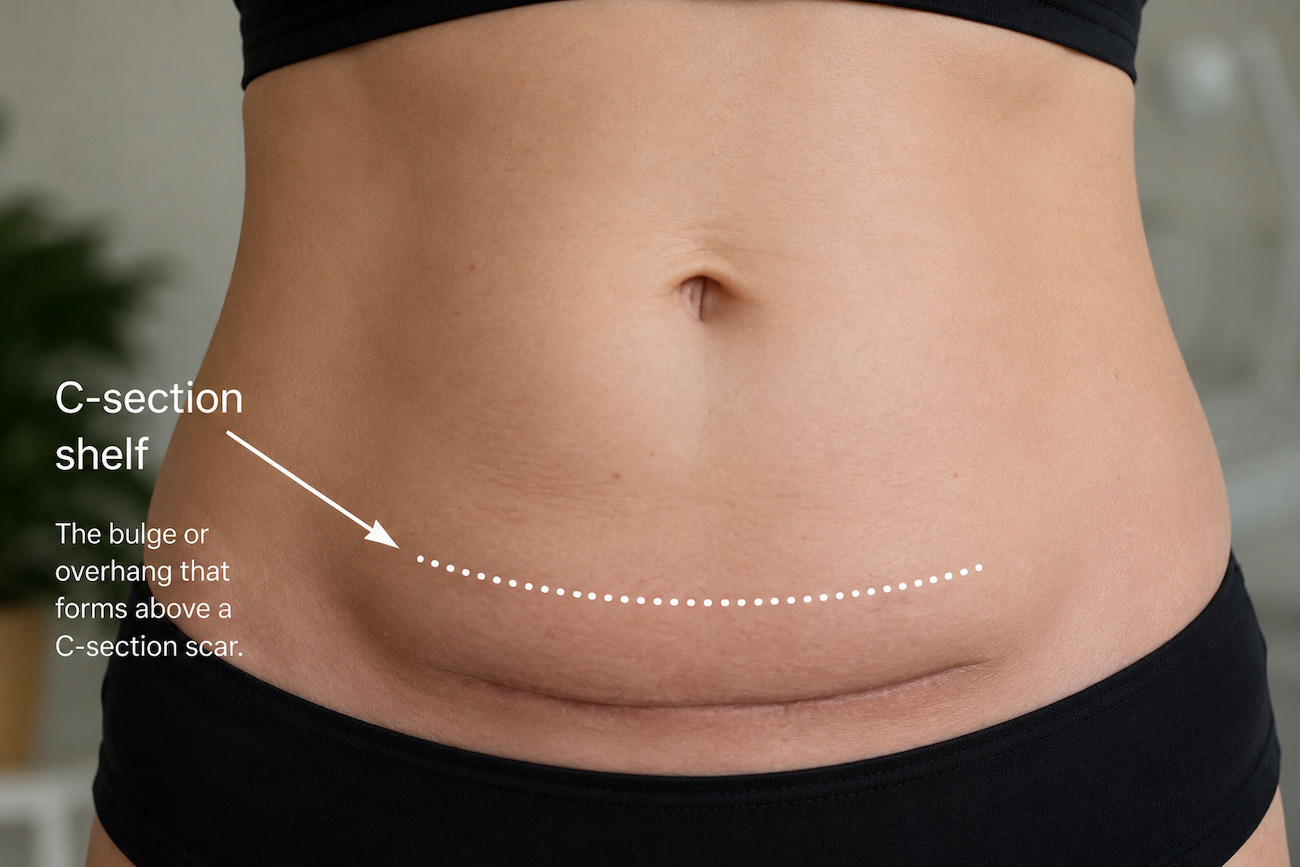
A C-section shelf is the bulge or overhang that forms above a Cesarean scar.
Some women notice it immediately after delivery. Others find that months or even years later, the tissue above their scar still protrudes despite exercising regularly, eating well, and returning to their pre-pregnancy weight.
Most women assume this “shelf” is simply excess fat or loose skin. But if that were true, every woman who lost weight after pregnancy would see it disappear. We know that’s not the case.
Just like a low belly pooch, a C-section shelf is often a sign that the natural sequence that supports your core has been disrupted:
Breath → Reflexive Core Function → Pressure Management → Organ Position → Symptoms
Here’s what that means:
Your breath is designed to reflexively coordinate your deep core muscles, including your diaphragm, abdominals, pelvic floor, and the fascial system that supports your organs.
When these muscles aren’t functioning well, pressure inside the abdomen becomes poorly managed. Over time, that pressure can contribute to your organs sitting lower and becoming compressed. And when pressure repeatedly pushes downward into tissues that have been stretched by pregnancy and are healing from surgery, the area above your scar can begin to protrude.
In other words, a C-section shelf is much more than a cosmetic concern. It’s your body communicating that the systems responsible for support, pressure management, and healing still need restoration.
Why Does a C-Section Shelf Happen?
So how do your organs end up sitting low and compressed in the first place?
It usually starts long before you ever notice the shelf.
Pregnancy and Cesarean delivery place tremendous demands on your core system.
Over the course of nearly ten months, your body undergoes one of the most remarkable transformations imaginable. Your organs shift to make room for your growing baby. Your diaphragm adapts. Your abdominal wall and pelvic floor lengthen and change under increasing load. Your fascia remodels. Even your breathing mechanics and pressure patterns begin to change.
Your body isn’t failing during this process. It’s adapting beautifully. And then comes delivery.
A Cesarean birth adds another layer to your recovery journey. Multiple layers of tissue are carefully moved and incised to safely bring your baby into the world. Your body immediately begins healing from both pregnancy and a major abdominal surgery simultaneously.
This is a tremendous physiological event.
And while your body is incredibly resilient and designed to heal, many women are never taught how to fully restore the systems that were stretched, displaced, and reorganized during pregnancy and birth.
Over time, these changes can disrupt what I call the natural sequence of core support:
Breath → Reflexive Core Function → Pressure Management → Organ Position → Symptoms
When this sequence becomes disrupted, pressure begins moving through your body differently. Your organs receive less support, tissues become compressed, and symptoms like a C-section shelf can begin to appear.
Let’s walk through how this happens.
Pregnancy and Surgery Change Your Core System
Your body spent nearly ten months adapting to pregnancy.
As your baby grew, your diaphragm, abdominal wall, pelvic floor, fascia, and organs all shifted to accommodate your changing body. Your tissues lengthened, your pressure system changed, and your center of gravity moved.
Then during a C-section, surgeons carefully cut through multiple layers of tissue to safely deliver your baby.
Your body is incredibly resilient and designed to heal. But healing and functioning are not always the same thing.
Without proper rehabilitation, many women never fully restore the reflexive coordination between their breath, diaphragm, deep core muscles, pelvic floor, fascia, and organs. Instead, the body develops compensations and protective patterns that persist long after delivery.
The result isn’t simply a “weak core.” It’s a core that has lost some of its natural coordination and support.
Scar Tissue Can Create Restriction
Scar tissue is a normal and necessary part of healing.
However, scar tissue can sometimes become restricted and lose its natural mobility. When this happens, the tissues around your incision may feel tight, numb, pulled, or stuck.
These restrictions don’t automatically create a C-section shelf.
The bigger issue is what happens when pressure from above repeatedly pushes into tissues that already have limited mobility. The tissues can’t glide and adapt the way they’re designed to, making the shelf above the scar more noticeable.
Pressure Starts Moving in the Wrong Direction
Here’s something most women are never taught:
Your body is managing pressure every second of every day.
Pressure isn’t bad. It’s part of being human.
You create pressure when you:
- Breathe
- Stand
- Lift your baby
- Carry a toddler
- Talk, cough, laugh, or sneeze
- Exercise
- Simply exist under gravity
The question isn’t whether you create pressure.
The question is: Where does that pressure go?
When your breath, diaphragm, deep core muscles, and pelvic floor are coordinating well, pressure is managed beautifully. Your organs stay supported, your tissues adapt efficiently, and your core functions the way it was designed to.
But after pregnancy and C-section delivery, this pressure-management system often becomes disrupted. Pressure begins moving downward instead of being absorbed, distributed and managed throughout the system.
This means exercise, or lack of exercise, is not what leads to a C-section shelf. It develops simply from living in a postpartum body that hasn’t yet restored her breathing mechanics, posture, reflexive core function, and pressure management.
That said, certain exercises can magnify these dysfunctional pressure patterns.
Think about all the traditional postpartum advice women are given:
- Crunches
- Sit-ups
- Planks
- Running
- HIIT workouts
- Intense ab exercises
Most women are told these exercises will flatten their stomach and strengthen their core. They Don’t!! They make things worse! They are actually harmful to a post partum core, especially one that is healing from a C-section.
If your body is already struggling to manage pressure, these exercises create even more downward force. That pressure doesn’t disappear. It has to go somewhere. And when your reflexive core system isn’t coordinating properly, pressure gets pushed downward into your pelvic floor, your organs, and the tissues surrounding your healing scar.
This is why so many women feel like they’re doing everything “right” but still aren’t seeing results. The issue isn’t that you’re exercising. And it’s not that you’re not exercising enough.
The issue is that your body never learned how to manage pressure well again after pregnancy and birth.
Organ Position Changes Everything
The position of your organs plays a huge role in the shape of your abdomen and the function of your entire core system.
Your organs aren’t simply passive structures sitting inside your body. They’re living, moving tissues that rely on pressure, fascia, and muscular support to stay lifted and centered.
When pressure is well-managed, your organs remain supported in their optimal position.
As a result:
- Your waist naturally becomes narrower
- Your low belly lifts with every breath
- Your lower abdomen feels flatter and supported
- Your core muscles coordinate efficiently
- Circulation, lymphatic drainage, and organ function is optimized
- Your entire system feels lighter and is more resilient
But when pressure continually moves downward, your organs begin to sit lower and become compressed. This changes more than the appearance of your belly.
Lower, compressed organs receive less space, less movement, and often less optimal circulation, lymphatic flow, and nervous system input. Over time, function can begin to suffer.
This is when symptoms often start to appear:
- C-section shelf
- Low belly pooch
- Bloating and constipation
- Pelvic pressure or heaviness
- Diastasis recti
- Bladder leaks and pelvic floor dysfunction
- Low back pain and feelings of instability
This is why many women can lose weight, exercise consistently, and still struggle with a C-section shelf.
The issue usually isn’t body fat.
It’s that the systems responsible for supporting your organs and managing pressure haven’t fully recovered.
Because ultimately, the shape and appearance of your belly is a reflection of organ position… and organ position is a reflection of core muscle function.
And when we restore this critical sequence:
Breath → Reflexive Core Function → Pressure Management → Organ Position
—symptoms often begin to improve naturally because your body is finally receiving the support she was designed to have.
How to Fix a C-Section Shelf
Traditional core exercises aren’t the solution to a C-section shelf. You can lose weight, lose body fat, and still have that shelf above your scar.
This explains why some women return to their pre-pregnancy weight and still struggle with a protruding lower belly, while others carry more body fat and have a flatter, more supported abdomen.
Because the issue usually isn’t body fat. It’s function.
More specifically, it’s whether your body has restored this sequence:
Breath → Reflexive Core Function → Pressure Management → Organ Position
When this sequence is disrupted, pressure moves downward, organs lose support, and the tissues above your scar often become the place where that pressure shows up.
But when we restore this sequence, something remarkable happens. Your breath begins coordinating your core muscles reflexively again. Pressure starts moving through your body more efficiently. Your organs receive better support and naturally begin to lift and center.
And as that happens, many women notice:
- A flatter, more supported lower belly
- Less pressure and pulling around the scar
- Improvements in diastasis recti
- Less bloating and constipation
- Fewer bladder symptoms and feelings of heaviness
- Less back pain and instability
- A core that finally feels strong, connected, and trustworthy again
After more than a decade and a half of helping women heal from core and pelvic floor dysfunction, I’ve seen this happen thousands of times.
When we restore pressure management and support the organs, everything else starts working better because the body is finally operating from a place of coordination instead of compensation.
Inside The Core Recovery Method®, I teach you exactly how to do this.
You’ll learn:
- How to breathe in a way that restores pressure balance and lifts your organs (yes, there is a right and wrong way to breathe!)
- How to retrain your deep core muscles to work reflexively and automatically throughout the day—not just during exercise
- How to stand, move, and carry your body in ways that support your organs and reduce unnecessary downward pressure
- Specific scar-mobility techniques that restore movement and reduce restriction around your incision
- How to decompress your spine and improve posture so your entire core system can function more efficiently
The goal isn’t to flatten your stomach by forcing it smaller. The goal is to restore the systems that were designed to support you in the first place. Because when your breath, core, pressure system, and organs are working together again, your body changes in ways that feel almost effortless. And perhaps most importantly, it begins to feel like yours again.
Here’s what happens when you support your body differently:
“I had C-sections with both of my babies, and after my first, I did everything I thought I was supposed to do. I lost the weight, exercised like crazy, worked with a pelvic floor physical therapist, and tried so hard to get my body back. But I still had a C-section shelf, constant bloating, and low back pain. My body just didn’t feel right.
Then I got pregnant again, and had a second C section. That’s when I knew I had to find a different approach. My friend referred me to Dr. Angie.
This time, my post partum recovery was completely different. I listened to my body, didn’t push through, and let my breathing be the foundation for all I did.
Inside The Core Recovery Method®, I learned how to breathe properly, manage daily pressure, and support my core in a way that actually made sense and felt good. I was honestly shocked to watch my C-section shelf disappear before my eyes—all while I was exercising less and eating more.
My bloating stopped, my belly became flatter and more supported, and I fit back into clothes I hadn’t worn since before my first pregnancy.
The most incredible part? I feel better after my second pregnancy than I did before my first. I finally feel strong, comfortable, and at home in my body again.”
— Sidney, Mom of Two
It's Never Too Late to Improve A C-Section Shelf
You grew and birthed a baby. You adapted to enormous physical, hormonal, and emotional changes. You recovered from pregnancy and major abdominal surgery. Your body has already proven she’s incredibly resilient.
But the truth is, most women are never taught how to restore their core after pregnancy and C-section delivery. Instead, they’re told to exercise more, lose weight, and hope their body eventually figures it out.
You deserve better than that.
A C-section shelf isn’t a sign that you failed. It’s a sign that your body is still operating from the same pressure patterns and compensations it adopted during pregnancy and recovery.
And the beautiful thing about patterns? They can be changed.
Inside The Core Recovery Method®, I teach you the same step-by-step process I use with my private clients to restore:
Breath → Reflexive Core Function → Pressure Management → Organ Position
You’ll learn the breathing techniques, hypopressive training, posture strategies, and movement principles that have helped thousands of women reduce abdominal pressure, improve scar mobility, eliminate the C section shelf and low belly pooch, restore core function, and feel supported in their bodies again.
Because you deserve more than being told to “just live with it.” You deserve to understand why your body changed. You deserve to know that healing is possible. And you deserve to feel strong, supported, and at home in your body again.
Because it’s not too late. And it never was.

